

WHY ANDROID IS THE LOGICAL CHOICE FOR REGISTER EPOS?
Android is the most prevalent global operating system and its market share is growing. Android has been the best-selling OS worldwide on smartphones since 2011 and on tablets since 2013. As of May 2017, it has over two billion monthly active users, the largest installed base of any operating system. Android’s market share is outpacing it rivals. Below is the market share from December 2019.
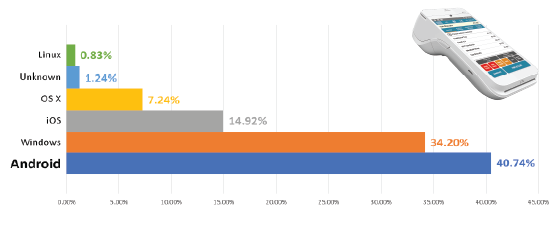
Operating System Market Share Worldwide
Source: https://gs.statcounter.com/os-market-share
Androids Drive into Enterprise
Android’s growth was initially driven by the lack of penetration of Windows on smart phones. Windows CE became Windows mobile, which was replaced with Windows phone, which in turn became Windows 10 mobile, which was also discontinued in 2017. This left Android and iOS as the operating systems of choice for smart phones. In the enterprise space Windows was heavily used by the likes of Motorola/Zebra and Honeywell for their predominantly mobile rugged computers. In relative terms compared to the desktop and consumer market, the Windows mobile enterprise space was very small. The enterprise rugged computer market then embraced Android as the operating system of choice. This came with the added advantage that there was no extra Android license fee like with Windows. Today the vast majority of enterprise mobile computers are Android.
Android and EPOS
With the advent of tablet computing, cost effective tablet based EPOS systems became popular on Android and iOS. Fundamentally a consumer based tablet on a stand in various guises. Next the mainstream EPOS manufactures started to create specific Android based hardware EPOS solutions. With the likes of HP, Pax, Sunmi, ELO, Partnertech, Verifone, Ingenico, Miura and Star now delivering Android based hardware EPOS products. This is the way the market is heading. These products are much more fit for purpose with customer facing displays, IP ratings (splash proof), built in printers, cash draw ports, integrated payment and commercial support packages. They are also well designed with no external cables and aesthetically pleasing, which is important for retail. Cost is also a key factor; these all-in-one solutions can cost less than a high end tablet and include associated hardware such as printer and customer display. This is a fast paced market with new Android based hardware coming to market regularly.
Android vs iOS
iOS lead the charge with tablet computing in general, was very on-trend and the initial forerunner for tablet based EPOS. iOS devices have some major draw backs for modern EPOS and in conjunction with the general popularity increase of Android and the release of specific and fit for purpose Android based EPOS hardware, Android has now become the logical choice.
The market has really moved on from tablets on a stand in general. We initially named our solution “Tablet Cash Register”, but we changed it to “Register”, as we are implementing more on the likes of Sunmi, Pax and HP that have integrated printers and customer displays.
Sometimes people think their users will better understand iOS and it will make for easier training. Firstly, when staff are working, they are using the EPOS application on the device, not iOS or Android. They are not using any specific iOS or Android gestures. As an example, we provided EPOS for a festival with 130 terminals, the bar managers were trained from scratch in 10 mins, they then trained their bar staff. There was no specific Android training at all and they executed over 40K transactions in a weekend.

iOS does not gain us or you anything for EPOS, that is why we don’t support it for in-store EPOS. iOS devices and peripherals are also relatively expensive. I.e. for the cost of an iPad you can get a specific and designed for purpose EPOS unit. Android is mainstream in this space now with the likes of Pax, HP, Sunmi, ELO all supporting it.
iOS will limit your choices in the future. As an iOS device is consumer focussed it is not specific for purpose. Secondly as the consumer hardware changes regularly, you need to keep your peripherals up to date. For example, when a new iPad device is released the stands and payment holders will need updating. We used to support iOS, and we had customers buying old iPods’s from eBay to keep going, as the ones that fitted their peripherals were no longer available. From a core technology perspective iOS is fundamentally a consumer focussed operating system. It typically does not play well with enterprise/commercial platform technologies such as mobile device management.
Finally, if you are looking at handheld EPOS now or in the future, again on iOS is problematic. We implemented one of the first iOS MPOS deployments in the UK. Again, the issues are that the hardware solution is made of separate components i.e. an iPod/iPhone, separate payment device/holder, printer and scanner. When the iPod/iPhone hardware is updated these peripherals are unlikely to fit. Also, the separates solution is cumbersome and more complex for connectivity. A far better solution for this is an all-in-one Android solution like the Pax A920 or Sunmi P2pro.
Android Vs Windows
Retailers (especially SME’s) want an EPOS system that is cost effective, provides functionality they need and is well supported. They don’t really care about the operating system, whether it be Windows, iOS or Android.
Firstly, lets address cost. Windows has a license fee paid to Microsoft, Android does not, this provides a cost reduction for Android based EPOS solutions. Windows based systems also tend to be more expensive overall. In general, we estimate Windows EPOS hardware to be up to 40% more expensive than Android.
Windows also comes with technical overhead compared to Android. Driver management, networking, OS updates and peripheral connectivity are all more complex.
Windows does not offer a solution for handheld EPOS with all-in-one payment. The closest you can achieve is a tablet with a payment device strapped to it. This is where the market is heading with the likes of Pax, Sunmi and Ingenico.
From a technical perspective there is no reason to deploy windows on EPOS other than legacy software and hardware support.
The hardware market is changing at pace. Some manufacturers are moving to Android only whilst other like HP are extending to support Android across their range.
Market Disturbance
A big change in the market is that traditional card payment device manufactures are moving into EPOS devices. Companies like PAX, Verifone and Ingenico are market leaders in card payment that now offer EPOS hardware with all in one payment modules. They are almost all exclusively supporting Android. Conversely EPOS manufactures are starting to build-in card payment.
Starting with desktop EPOS, i.e. a large screen EPOS with integrated payment, manufacturers are now moving into handheld based EPOS with payment. This is causing a disturbance in the market. Basically, being able to run full EPOS on your payment device. If you want a true all in one handheld device, with full EPOS functionality, card payment printing and scanning, Android is the only choice. This is also very cost effective.
In short payment and EPOS hardware is merging and moving to Android especially in the SME space. This is already having affect in the market with some payment providers only offering Android based solutions. They can sell the same device for “EPOS” and for “payment only” whilst providing an upgrade path. Over time it is very likely that all payment terminals will move to run on Android. Android is moving into retail whether it is being explicitly utilised or not and in turn this will continue to drive its overall proliferation.
